Sol Plaatje Memorial Week 2026

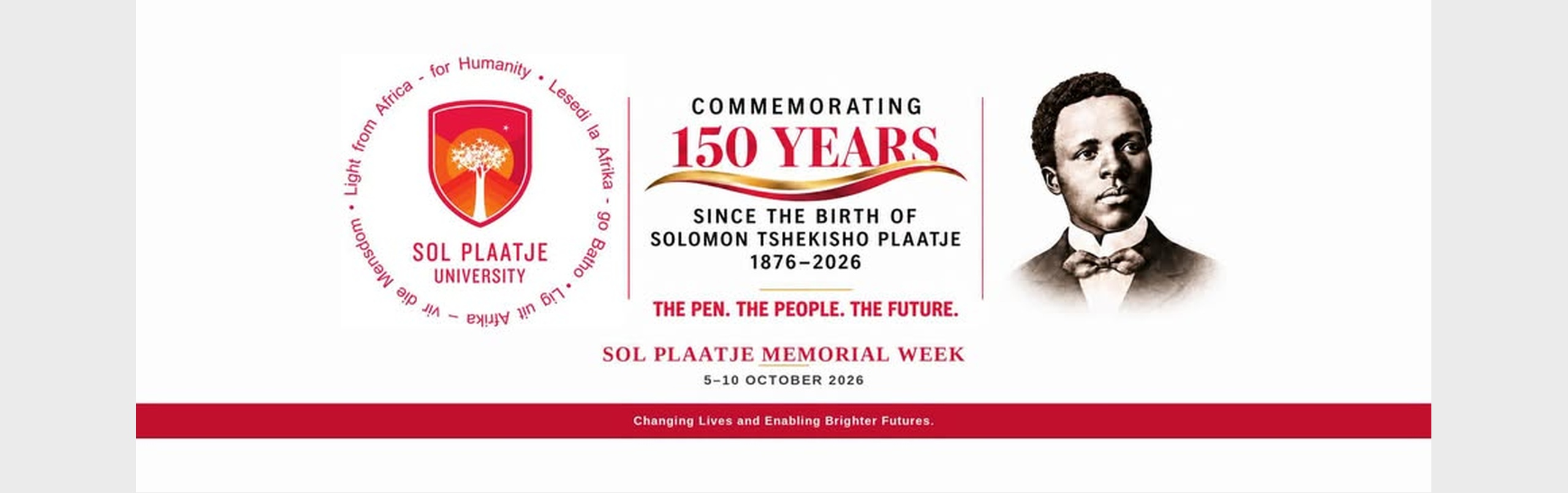
As part of the commemoration of the 150th anniversary of the birth of Solomon Tshekisho Plaatje, Sol Plaatje University will host Sol Plaatje Memorial Week from 5 to 10 October 2026.

Programme Overview:
 
Monday, 5 October 2026
  • 10:00 | Official Opening by Honourable Buti Manamela
    Minister of Higher Education and Training
    Address:
    Reflections on Sol Plaatje’s legacy | Venue: SPU Library Auditorium
    Thereafter
    | Commemorative Stamp Unveiling, officiated by the Minister
    Venue:
    Sol Plaatje Museum, 32 Angel Street
  • 14:00 – 16:00 | Sol Plaatje and Setswana Panel Discussion

    Speakers: Dr Otshepeng Moletsane and Dr Lesley Mofokeng
    Venue: Library Auditorium
Tuesday, 6 October 2026
  • 10:00 -12:00 | Panel Discussion: Mhudi and Native Life in South Africa
    Speakers: Prof Shole J. Shole and Dr Eileen Pooe
    Venue: Library Auditorium
     
  • 13:00 -15:00 | Public Lecture: Locating Sol Plaatje in the Age of decoloniality and planetary consciousness
    Speaker: Dr Sebeka Plaatjie
    Venue: Library Auditorium
Wednesday, 7 October 2026
  • 09:00 – 20:00 | Chancellor’s Football Programme
    Speaker: Mr Pitso Mosimane
    Venue: South Campus
  • 10:00 – 12:00 | Panel Discussion: 110 Years of Native Life in South Africa
    Speakers: Prof Brian Willan and Dr Janet Remmington (UK, online)
    Venue: Library Auditorium
  • 14:00 – 15:00 | Education-focused Public Lecture: What Do We Need to Remember About Sol Plaatje and Education? 
    Speaker: Prof Brian Willan
    Venue: Library Auditorium
Thursday, 8 October 2026
  • 12:00 – 14:00 | Book Launch: Biography of Isaiah Bud-M’Belle by Prof Brian Willan and Dr Brown Maaba
    Speakers: Prof Brian Willan, Dr Brown Maaba and Dr Janet Remmington
    Venue: Library Auditorium
     
  • 16:00 – 17:30 | Justice Yvonne Mokgoro Judicial Roundtable
    Speakers: Judge Violet Phatshoane, Justice Steven Majiedt and Prof Githu Muigai
    Venue: Library Auditorium
     
  • 18:00 | Solomon Tshekisho Plaatje 150th Anniversary Gala Dinner (per invitation)
    Keynote Speaker: Dr Zamani Saul
    Venue: SPU Great Hall
Friday, 9 October 2026
  • 10:00 – 12:00 | Launch of the!Xao Journal for New Writing
    Speaker: Mr Tuelo Gabonewe
    Venue: Library Auditorium
     
  • 12:00 – 14:00 | Discussion on Sol Plaatje’s Intellectual Legacy, Literary Contributions, Historical and Decolonial Relevance
    Speaker: Prof Chitja Twala
    Venue: Auditorium A, Education Building, Central Campus, 26 Scanlan Street, Labram, Kimberley
  • 16:00 – 18:00 | Annual Sol Plaatje Memorial Lecture and Roundtable Discussion
    Keynote Speaker and panelists: Justice Dikgang Moseneke, Prof Tshepo Madlingozi, Prof Brian Willan, Dr Sebeka Plaatjie, Mr Sabata-mpho Mokae and Mr Mbulelo Gobo
    Venue: Library Auditorium
Saturday, 10 October 2026
  • 07:00 – 20:00 | Chancellor’s Golf Day
    Venue: Kimberley Golf Club
  • 10:00 – 18:00 | SPU Alumni Homecoming 2026
    Speaker: Prof Mantoa Motinyane
    Venue: South Campus Multipurpose Hall

Sol Plaatje Memorial Week affirms that Plaatje’s legacy is not confined to history but remains a living intellectual and civic resource through which contemporary questions of knowledge, justice, language, dignity and social responsibility can be examined anew.

About Sol Plaatje

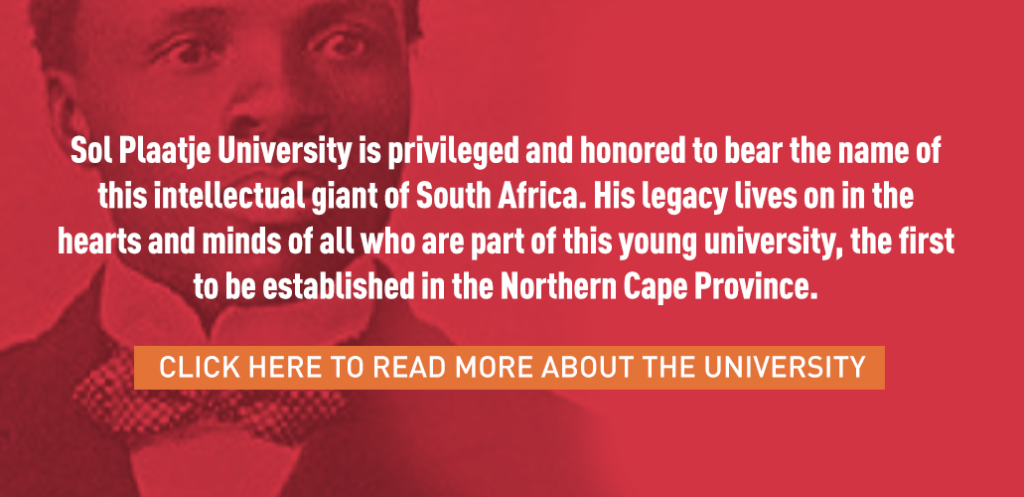
Solomon Tshekisho Plaatje (9 October 1876 – 19 June 1932) was a South African intellectual, journalist, linguist, politician, translator and writer. Plaatje was a founder member and first General Secretary of the South African Native National Congress (SANNC), which became the African National Congress (ANC). The Sol Plaatje Local Municipality, which includes the city of Kimberley, is named after him, as is the Sol Plaatje University in this city, which opened its doors in 2014.  

Plaatje was born in Doornfontein near Boshof, Orange Free State (now Free State Province, South Africa), the sixth of eight sons. His grandfather’s name was Selogilwe Mogodi but his employer nicknamed him Plaatje and the family started using this as a surname. His parents Johannes and Martha were members of the Tswana nation. They were Christians and worked for missionaries at mission stations in South Africa.

When Solomon was four, the family moved to Pniel near Kimberley in the Cape Colony to work for a German missionary, Ernst Westphal, and his wife Wilhelmine. There he received a mission-education. When he outpaced fellow learners he was given additional private tuition by Mrs Westphal, who also taught him to play the piano and violin and gave him singing lessons.

After leaving school, he moved to Kimberley in 1894 where he became a telegraph messenger for the Post Office. He subsequently passed the clerical examination (the highest in the colony) with higher marks than any other candidate in Dutch and typing. At that time, the Cape Colony had qualified franchise for all men 21 or over, the qualification being that they be able to read and write English or Dutch and earn over 50 pounds a year. Thus, when he turned 21 in 1897, he was able to vote, a right he would later lose when British rule ended.

Shortly thereafter, he became a court interpreter for the British authorities during the Siege of Mafeking and kept a diary of his experiences which were published posthumously.

After the war, he was optimistic that the British would continue to grant qualified franchise to all males, but they gave political rights to whites only in the 1910 Union of South Africa. Plaatje criticised the British in an unpublished 1909 manuscript entitled “Sekgoma – the Black Dreyfus.”

As an activist and politician he spent much of his life in the struggle for the enfranchisement and liberation of African people.

Plaatje became fluent in at least seven languages and translated works of William Shakespeare into Tswana. His talent for language would lead to a career in journalism and writing. He was editor and part-owner of Koranta ea Becoana (Bechuana Gazette) in Mafikeng, and in Kimberley Tsala ea Becoana (Bechuana Friend) and Tsala ea Batho (The Friend of the People).

Plaatje was the first black South African to write a novel in English – Mhudi. He wrote the novel in 1919, but it was only published in 1930.

He was married to Elizabeth Lilith M’belle, a union that would produce five children – Frederick, Halley, Richard, Violet and Olive.

He died of pneumonia at Pimville, Johannesburg on 19 June 1932 and was buried in Kimberley. Over a thousand people attended the funeral.


Decades passed before Plaatje began to receive the recognition he deserved.

In the 1970s interest was stirred in Plaatje’s journalistic and literary legacy through the work of John Comaroff (who edited for the publication of The Boer War Diary of Sol T. Plaatje, and by Tim Couzens and Stephen Gray (who focused attention on Sol Plaatje’s novel, Mhudi.) 

Rapidly, his intellect and influence became widespread and respected. Among the many posthumous tributes to Plaatje are:

1978: Mhudi was re-published under the editorial guidance of Stephen Gray.

1982: Plaatje’s Native Life in South Africa: Before and Since the European War and the Boer Rebellion (1916) was re-published by Ravan Press.

1982: the African Writers Association instituted a Sol Plaatje Prose Award.

1984: Brian Willan published his biography, Sol Plaatje: South African Nationalist, 1876–1932.

1991: The Sol Plaatje Educational Trust and Museum, housed in Plaatje’s Kimberley home at 32 Angel Street, was opened, actively furthering his written legacy.

1992: The house at 32 Angel Street in Kimberley, where Plaatje spent his last years, was declared a national monument (now a provincial heritage site). It continues as the Sol Plaatje Museum and Library, run by the Sol Plaatje Educational Trust, with donor funding.

1998: An honorary doctorate was posthumously conferred on Plaatje by the University of the North-West, with several of his descendants present.

1998: Plaatje’s grave in West End Cemetery, Kimberley, was declared a national monument (now a provincial heritage site).It was only the second grave in South African history to be awarded national monument status.

2000: The Diamond Fields Advertiser launched the Sol T Plaatje Memorial Award to honour the top Setswana and top English matriculant each year in the Northern Cape.

2000: The Department of Education building in Pretoria was renamed Sol Plaatje House, on 15 June 2000, “in honour of this political giant and consummate educator.”

2000: The South African Post Office issued a series of stamps featuring writers of the Boer War, with Plaatje appearing on the 1.30 Rand stamp.

2018:  Acclaimed historian Brian Willan released his fourth book on Sol Plaatje with a landmark launch at the University.