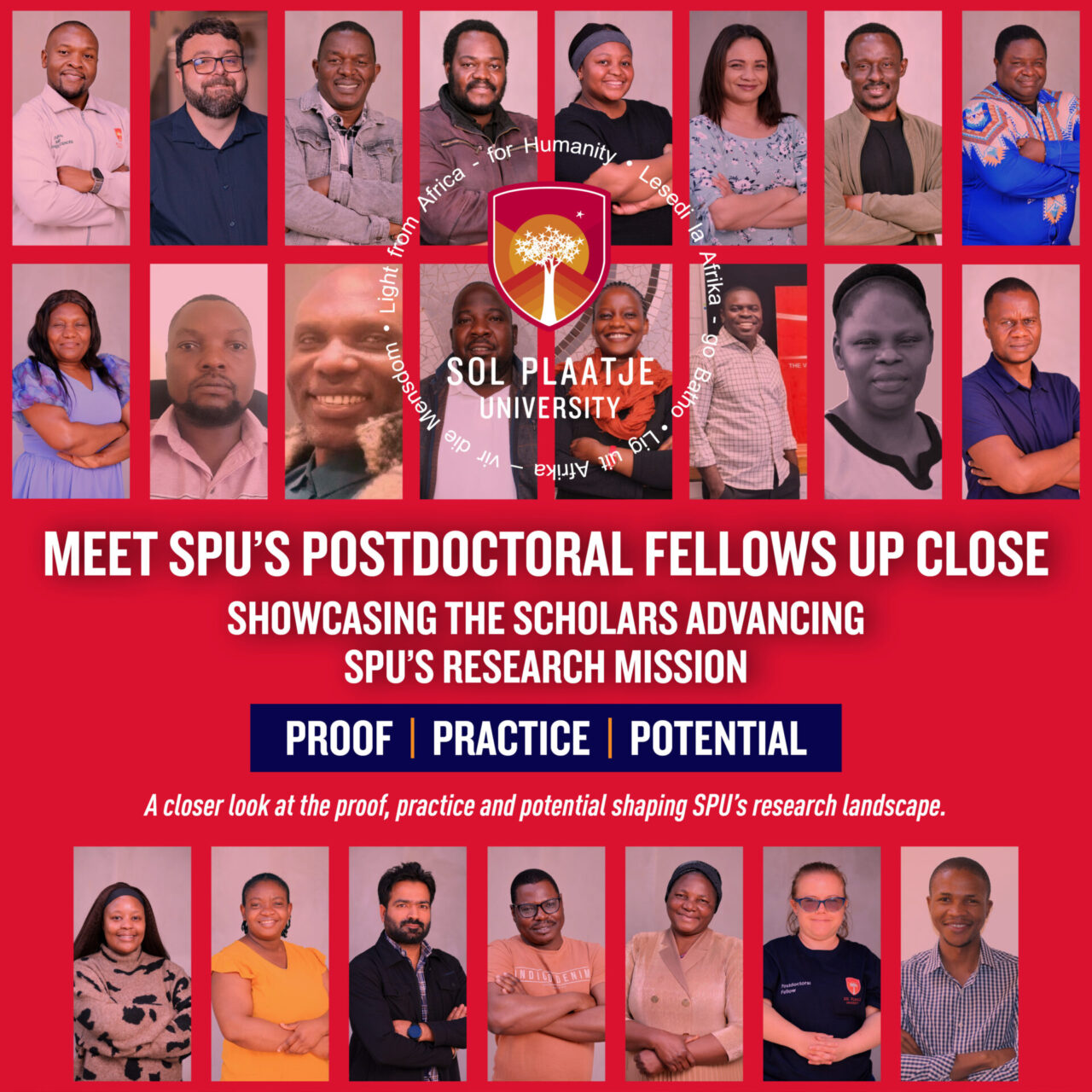
Research is one of the most powerful ways a university contributes to society and today we continue our Postdoctoral Fellows Up Close series by spotlighting the scholars who carry that responsibility with distinction. Our Postdoctoral Research Fellows are not only researchers. They are thought leaders. They are innovators. They are early career academics whose work is helping to shape new understanding across our disciplines and across our province.
This series invites you to look closely at the people behind the research. These are scholars who ask bold questions, apply advanced methods and generate knowledge that strengthens our University and supports the development priorities of the Northern Cape.
Today’s Postdoctoral Fellows Up Close introduces Fellows whose work spans Natural and Applied Sciences, Creative Writing and African Languages and Education. Each profile offers insight into their focus areas, current research direction and the scholarly contribution they bring to SPU.

Dr Naledi Zama
A Postdoctoral Research Fellow within the Centre for Global Change (Faculty of Natural and Applied Sciences), Dr Zama specialises in grassland and rangeland ecology, focusing on soil–plant interactions, climate variability and ecosystem functioning. Her work involves advanced statistical modelling using ecological datasets, supporting sustainable land management, climate resilience, and community engagement. She has presented nationally, received research awards, and supports postgraduate training. Dr Zama also serves as an Assistant Editor for Grassroots, a popular science magazine.
Dr Tolulope Ayodeji Olatoye
Dr Olatoye, a Postdoctoral Research Fellow in Geography Education and Social Sciences Teaching (Faculty of Education), holds a PhD in Geography from the University of Fort Hare, alongside master’s degrees in GIS and Geography. His expertise spans environmental and human geography, geospatial applications, and geography-in-education. His current projects include multidisciplinary work with the Faculty of Education, the Centre for Global Change and the Arid Region Water Research Centre, focusing on sustainability, resilience, environmental resource management and equitable futures through geospatial technologies.
With over two decades of academic and professional experience, Dr Olatoye has authored more than 25 peer-reviewed publications, delivered over 20 international conference papers, and earned prestigious awards, scholarships and competitive grants. His contributions include serving as an NRF panellist and reviewer. He also brings extensive experience in higher education teaching and postgraduate supervision.


Dr Simbarashe Jombo
A dedicated early-career researcher in the Faculty of Natural and Applied Sciences, Dr Jombo specialises in the application of remote sensing, GIS and machine learning for environmental management and sustainable development. His research focuses on land degradation, climate vulnerability, sustainable land use and climate change impact modelling. He applies advanced geospatial and deep learning methods to improve land cover classification, crop monitoring and ecosystem resilience. His interdisciplinary expertise supports climate resilience, food security and sustainable land management initiatives relevant to the socio-ecological context of the Northern Cape and broader global environments.
Dr Aaron Chando
A Postdoctoral Research Fellow in the Centre for Creative Writing and African Languages (Faculty of Humanities), Dr Chando holds a Doctorate from the University of the Witwatersrand and a Doctoral certificate in Global South Studies from the University of Tübingen. His research explores African and Postcolonial Literature and Cultural Studies with a focus on gendered identities, institutionalised violence and the politics of belonging in the Global South.
His work examines how creative writers engage with themes of precarity, vulnerability and cultural identity, particularly within Zimbabwean literature. Dr Chando foregrounds African creative artists as cultural thinkers whose work reimagines social issues and challenges dominant narratives within postcolonial contexts.

As SPU continues to grow, it remains committed to nurturing emerging scholars who bring intellectual depth, innovation and global perspective into our academic community. Through their contributions, SPU strengthens its research capacity, builds strategic partnerships across sectors, and positions the University as a hub for inclusive growth, knowledge creation and research-driven development in the Northern Cape and beyond.
