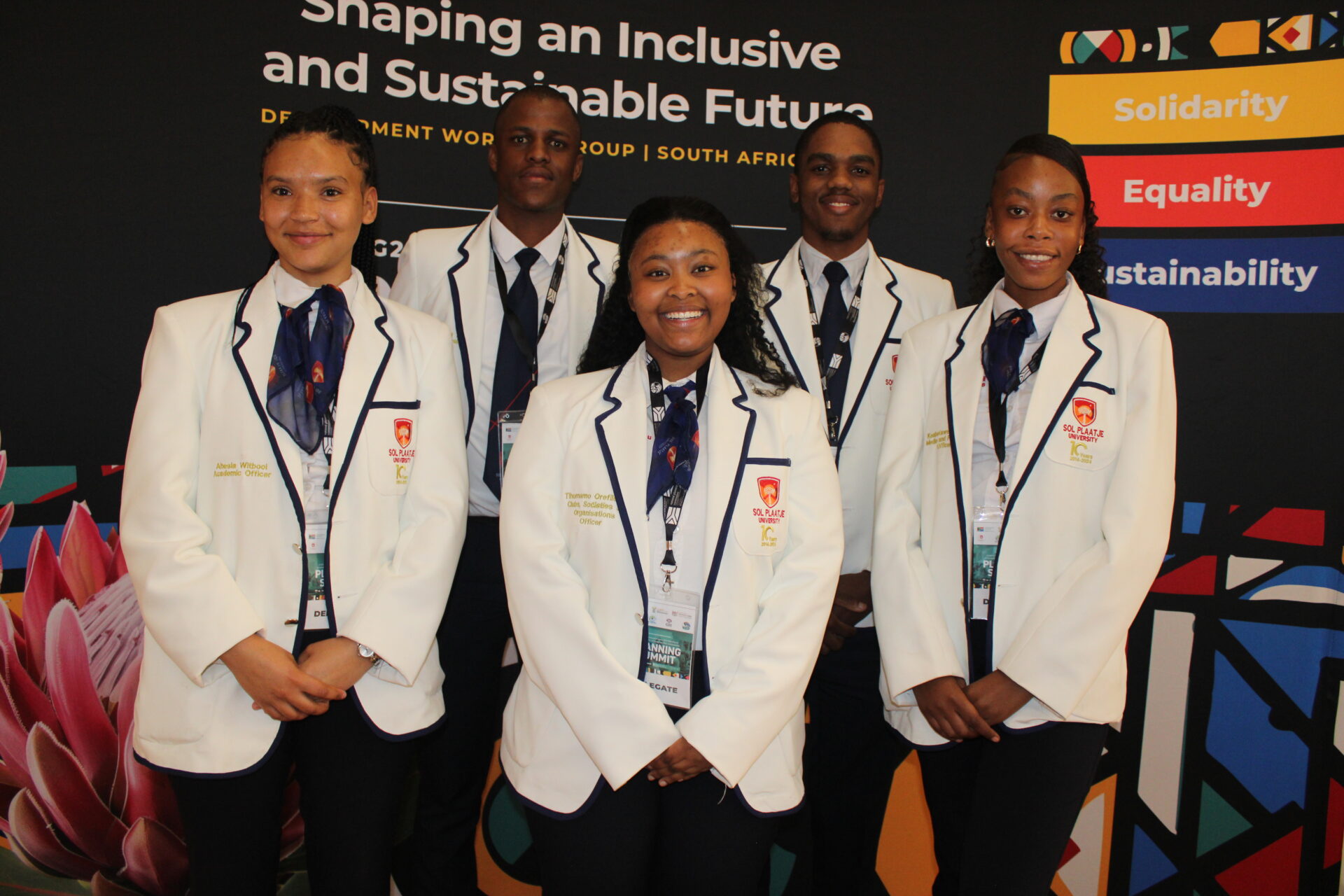
Sol Plaatje University’s (SPU) Student Representative Council (SRC) made a pivotal and courageous contribution at the recent G20 Planning Summit, hosted at SPU from 12-13 June 2025. Representing the voice of South African youth during Youth Month, the SRC joined national stakeholders in reimagining the country’s development future – while powerfully asserting that South Africa’s long-term planning cannot exclude those who will live it.
The SPU SRC delegation included Obakeng Tau (Deputy President), Tshiamo Mase (Deputy Secretary-General), Ahesia Witbooi (Academic Officer), Keabetswe Lebudi (Media and Publicity Officer), and Tlhomamo Tau (Clubs, Societies, and Organisations Officer).
Their intervention raised pressing concerns around the exclusion of youth from meaningful development processes, and they issued a call for intergenerational planning pathways that reflect the diverse realities of all South Africans – particularly those from underserved regions like the Northern Cape.
They questioned why South Africa’s long-term planning remains aspirational rather than binding, with limited consequences for non-delivery. Referring to the 2014 and 2020 NDP Implementation Reports, they highlighted persistent failures in youth employment, spatial justice and basic education. As a solution, they proposed the establishment of an NDP Implementation Tribunal, operating under the National Planning Commission (NPC), to monitor compliance every two years, publicly track departmental performance and link progress to Treasury budget approvals.
The SRC also raised concerns about the dominance of Western-centric data frameworks in development planning, describing it as a form of “data colonialism.” They challenged planning institutions to move beyond GDP and urban-centric metrics and instead incorporate indigenous knowledge systems, informal economies and rural epistemologies. They emphasised that current planning tools, including Municipal Integrated Development Plans (IDPs), overlook vital local systems such as communal grazing and traditional water management practices. To address this gap, they called for the establishment of an Indigenous Planning Observatory – a collaborative platform that brings together rural communities, academic institutions and local government to co-create contextually relevant planning models.
Furthermore, they cautioned that without deliberate and consistent youth involvement, long-term development plans risk becoming disconnected from the lived realities of the majority. They urged the state and the NPC to move beyond consultation and embed mechanisms that allow youth to shape and influence development planning at all levels.
The SPU SRC’s contribution to the G20 Planning Summit was not only timely – it was bold, thoughtful and aligned with the spirit of Youth Month, which commemorates the activism of generations past. Their leadership reflects SPU’s mission to graduate socially conscious citizens who advance democracy, development and social justice.
In amplifying the marginalised voices of youth and rural communities, SPU’s student leaders have reaffirmed the university’s place in shaping a transformative, inclusive South Africa.
