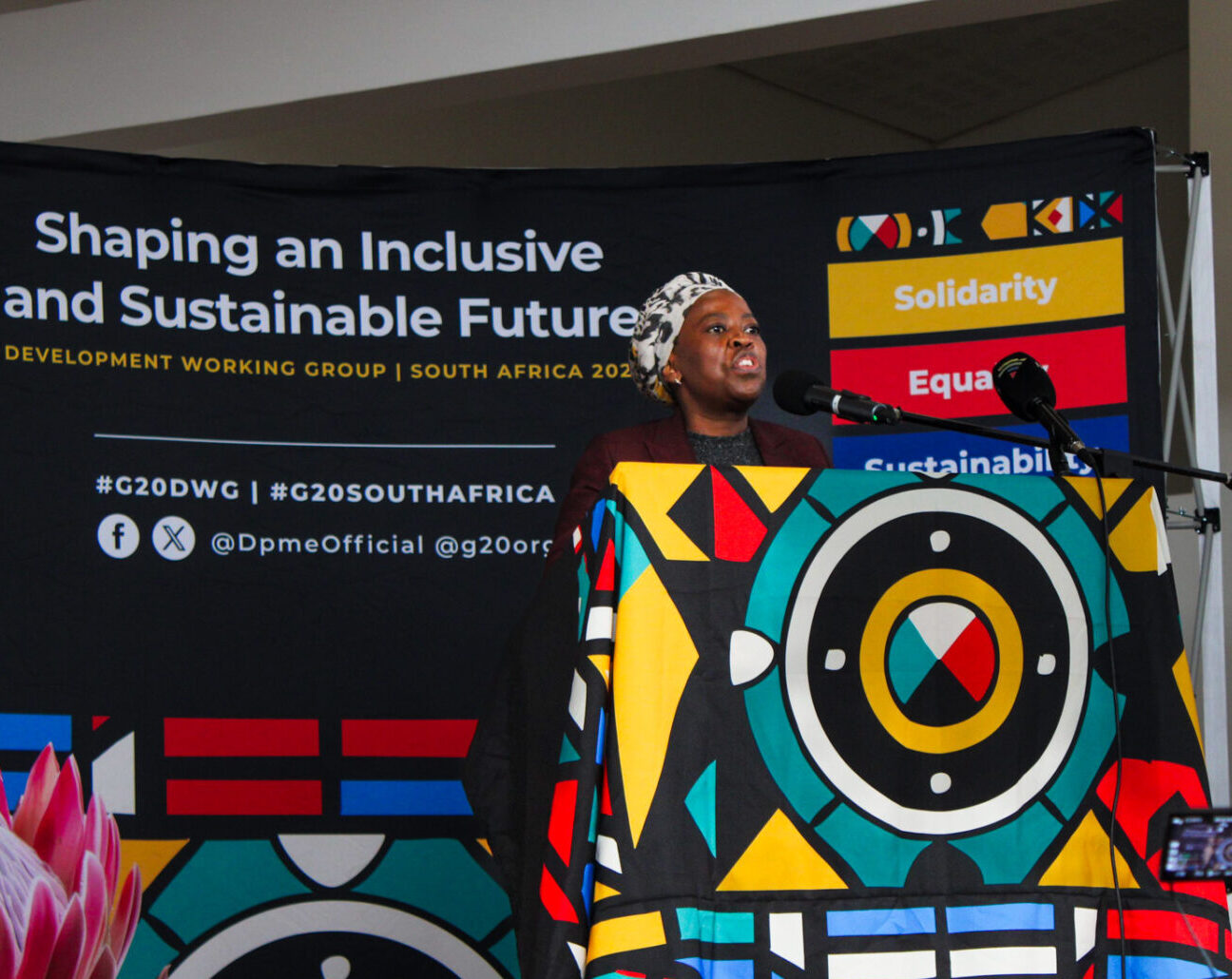
Following her keynote address at the recent G20 Planning Summit hosted at Sol Plaatje University (SPU) on 12 & 13 June 2025, Minister in the Presidency for Planning, Monitoring and Evaluation, Ms Maropene Ramokgopa, engaged with SPU to reflect on the strategic role universities, particularly those rooted in regions like the Northern Cape can play in shaping South Africa’s planning, monitoring, and evaluation agenda to drive inclusive development. In a country as complex and unequal as South Africa, universities like SPU play a critical role not only as a hub of knowledge, but as engines of social justice, democratic renewal, and inclusive development, which reflect the vision of SPU to be “an institution critically engaged in learning, research, and development – while enhancing democratic practice and social justice in society”.
Building a Nation that Works for All
Talking about the role universities can play in national and regional long-term planning frameworks to accelerate inclusive development, Ms Ramokgopa stated that South African universities are important partners for government’s interventions in policy development and supporting the implementation of plans and policies. “Universities such as SPU bring unique insights and strengths, such as applied research, monitoring and skills development, and advancing the collaboration government is emphasising, of bringing together all society in building a nation that works for all”.
She added that the wealth of knowledge universities have in its research capacity can be pivotal in intentional building in the capabilities of the work force by aligning training with not only the skills but studying global trends, scenario planning and ensuring that the workforce is fit for purpose for the immediate and distant future which directly addresses challenges in South Africa’s unemployment crisis. “This is especially important, as government implements the Medium-Term Development Plan (MTDP), and convenes the National Dialogue, which aim to build a socially cohesive nation which sees inclusive growth, job creation, and strengthened state capacity”.
Collaboration is Key
South Africa’s just energy transition priorities and the Northern Cape’s role in renewable energy, call for collaboration between academia, government and industry to ensure a sustainable, skills-driven energy future. With SPU’s plans to soon launch the Centre for Renewable Energy, she states how academia, government and industry can collaborate: “SA’s just transition must be met by collaboration between government, academia, civil society, the private sector, and all stakeholders should focus on delivering jobs, developing skills, and broad-based prosperity”.
Ms Ramokgopa further added that South Africa’s industrial policy focuses on reducing carbon emissions with people at its centre, with partnerships key to ensuring workers aren’t left behind in the transition, people will require the necessary skill sets for the green energy sector, where technicians and engineers are often required and the education system should deliver graduates with these skills, with STEM education at its centre.
To ensure that national development planning meaningfully includes the voices of youth and rural communities, particularly in shaping policies for education, employment, and innovation, she stresses the importance of the having deliberative and participatory spaces between government, citizens, especially youth and rural communities, the private sector and all stakeholders through interventions such as the District Development Model and the recent National Planning Commission Summit. The National Dialogue, which includes all of society, will greatly support leaving no one behind in the country’s development planning, as South Africans collectively find impactful solutions for the country’s challenges and achieve our development goals.
The implementation of the MTDP, the programme of action guiding the work of the 7th administration, emphasises a whole-of-society approach, meaning, government’s collaboration and partnership with communities, the private sector, academia, labour, and all stakeholders is essential to translating the MTDP into practical, measurable improvements in the lives of all South Africans. This will be achieved by putting at the centre marginalised communities.
SPU’s Commitment
As SA navigates the complex task of planning for an inclusive and sustainable future, institutions like SPU continue to play a critical role beyond teaching and learning. SPU actively supports the principles of participatory governance and democratic accountability through community-driven research and community engagement initiatives. These efforts are not incidental but are embedded in the heart of SPU’s vision. SPU remains a committed partner in building a more just, capable, and responsive society.
