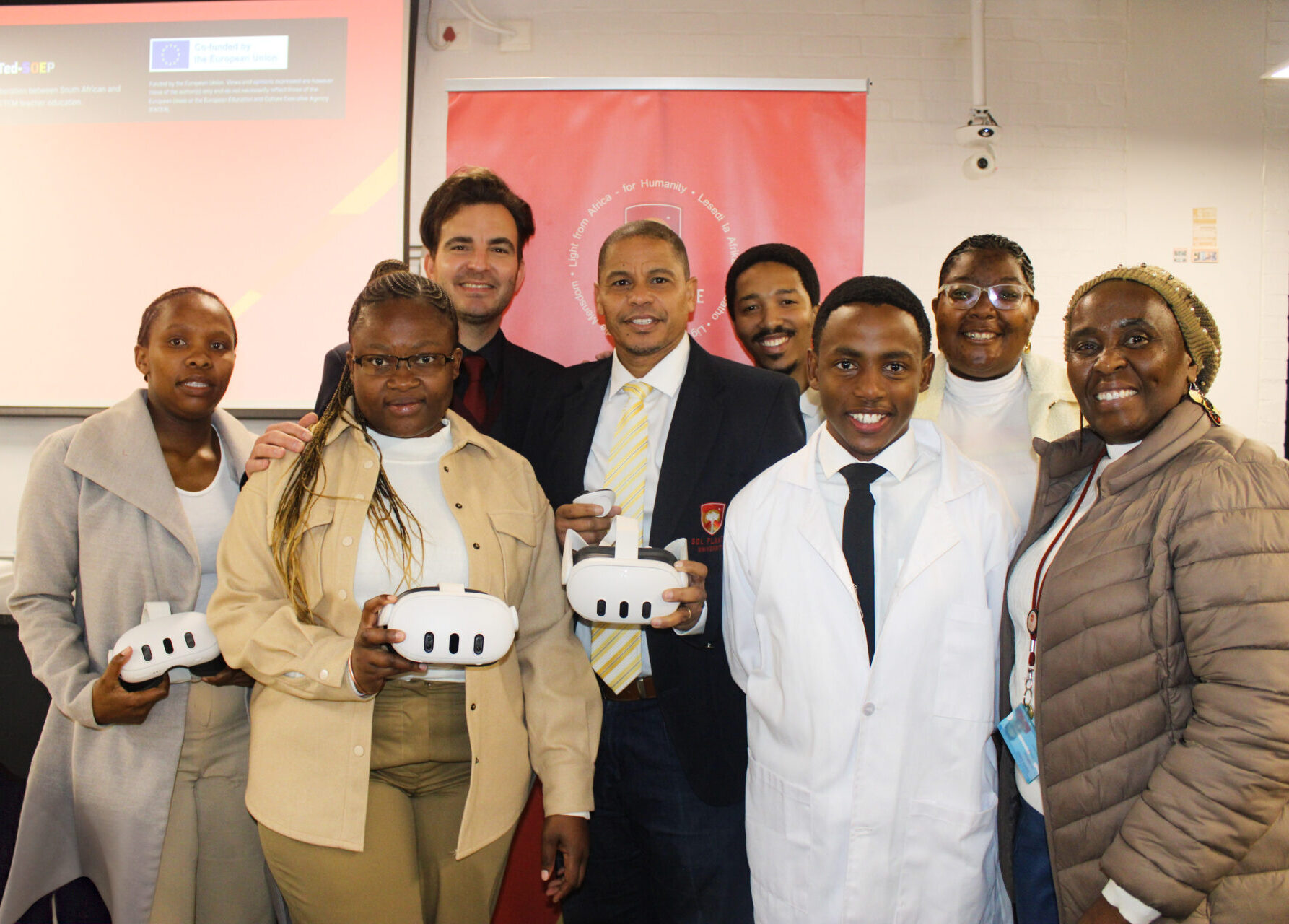
At Sol Plaatje University (SPU), the mission to graduate socially responsive, competent, and community-engaged citizens is not just a guiding principle, it is a lived reality. This is exemplified by a group of students in the Postgraduate Certificate in Education (PGCE) programme specialising in Life Science teaching: Omolemo Letlhaku, Dylan Jaftha, Alungile Nqeketo, Bathabile Kgarebe, Sindisiwe Maswanganyi, and Rick Arthur. These future educators are leading the way in integrating virtual reality (VR) into STEM (Science, Technology, Engineering and Mathematics) education as part of their teaching practice.
The group launched their innovative initiative on 29 July 2025with the aim of equipping pre-service teachers with cutting-edge techniques that make complex scientific concepts more engaging and accessible. By using VR, the students are not only deepening their own understanding of challenging topics in Life Science but also envisioning how immersive technology can transform science instruction in the modern classroom.
In his remarks at the launch, Deputy Vice-Chancellor for Teaching and Learning, Prof Paul Green, expressed his pride in the students’ initiative, particularly in how they demonstrated the meaningful role technology can play in bridging the gap between teaching and learning. He emphasised that Artificial Intelligence (AI) and digital innovation are not things to be feared, but rather embraced, and should become integral components in the design and delivery of the curriculum.
Prof Boitumelo Diale, Dean of the Faculty of Education, applauded the hard work of the students, and further highlighted how VR aligns with inclusive education practices, noting its potential to support diverse learning needs by increasing accessibility, clarifying complex concepts, and fostering greater learner engagement across varied educational contexts.
The student initiative is guided by Dr Wiets Botes, Head of the Department of Mathematics, Science, and Technology Teaching in the Faculty of Education. He explained that the project emerged from the Life Science Teaching module, where students explore the use of 360-degree videos to teach topics aligned with the school syllabus. “The integration of creativity, technology, and curriculum-focused teaching will prepare students for the dynamic 21st-century classroom,” said Dr Botes. “My goal is to ensure that, upon graduating, they feel confident and competent in incorporating emerging technologies into their classrooms.”
The students plan to take the initiative to under-resourced schools in the region to expose learners to the world of VR. They also intend to collaborate with SPU’s Centre for Teaching, Learning and Programme Development to explore how VR can simplify teaching and learning for both SPU students and lecturers.
Through their participation in VR-based learning and the development of digital simulations, these PGCE students exemplify SPU’s commitment to producing forward-thinking educators who embrace innovation, foster deep learning, and contribute to transformative education in the Northern Cape and beyond.
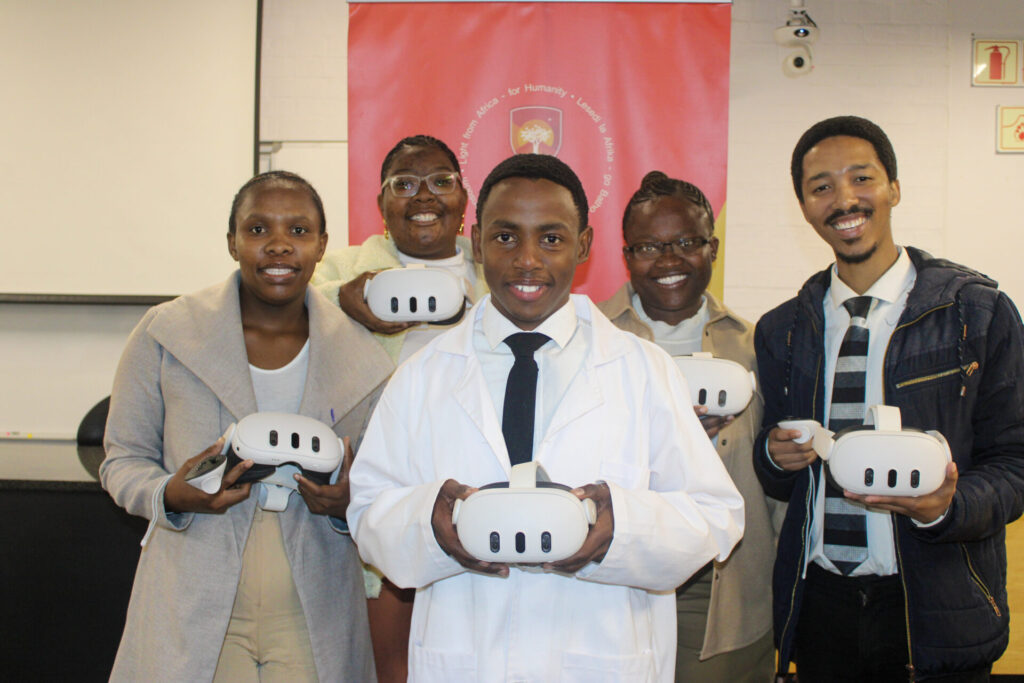
Front: Omolemo Letlhaku.
Back: Alungile Nqeketo, Bathabile Kgarebe, Sindisiwe Maswanganyi and Dylan Jaftha.
