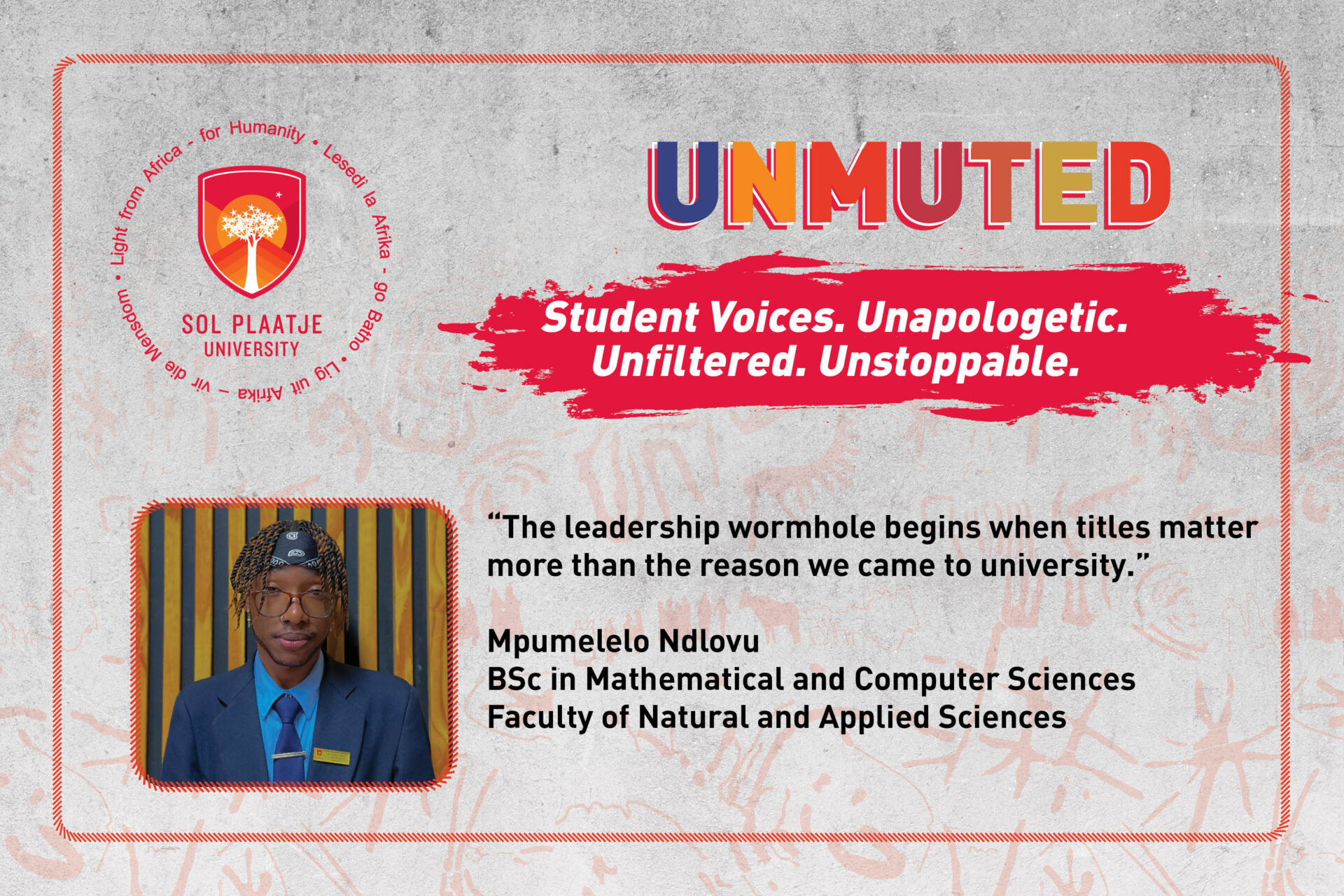
As part of the UNMUTED series – a digital space created to spotlight bold, unfiltered student voices in the lead-up to SPU’s Youth Dialogue tomorrow – we share this compelling opinion piece by Mpumelelo Ndlovu, a Student Media Assistant working in the Department of Institutional Advancement and currently enrolled for a Bachelor of Science degree in Mathematical & Computer Sciences. His article challenges us to reflect on leadership, relevance and responsibility in our institutions.
When I was initially asked to write an article sharing some of my unfiltered views, there were no restrictions on the topic. So I thought, “Well, I’ve been a student leader myself for quite some time now – why not write about some of my observations from that experience, particularly what I’ve come to see as a student leadership wormhole in our institutions of higher learning?”
Why do I refer to it as a ‘wormhole’? Because I’ve seen it happen year after year: student leaders come and go, yet a cycle begins – a recycling of the same individuals or an over-attachment to leadership roles. Some students cling to these positions, not necessarily because they still have something new to offer, but because of what the role gives them: access, relevance and perks. It becomes more about staying in leadership than growing through it.
To be clear, I’m not saying it’s inherently wrong to serve in leadership for many years. Many global leaders have done so. I’ve also been in leadership for three years now, which is a fairly long time for a student, in my opinion. But there’s a stark difference between progressive leadership that evolves, and stagnant leadership that holds on to power simply for the sake of remaining in it.
As much as student leaders contribute significantly to the functioning of higher education institutions, student leadership – for the student – should be a platform, not a destination. It should empower you intellectually, socially and personally – while enabling service to others.
At institutions like SPU, many of us come from diverse and often marginalised backgrounds. University becomes a gateway to a more fulfilling life, offering access to resources and experiences we never imagined. But the core reason most of us come to university remains simple: to study, graduate and change our lives.
Yet when students gain access to leadership, some lose sight of that mission. Structures like the Student Representative Council (SRC) open doors to privileged spaces that ordinary students may never enter. That access can be intoxicating. In some cases, it becomes addictive. The perks, the visibility, the sense of power – once you’ve had a taste, the idea of returning to life outside of that sphere can feel almost impossible.
That’s where the wormhole begins. When the pursuit of influence overtakes the pursuit of a degree, we face a crisis. The longer student leaders remain in this loop, the further they drift from the purpose that brought them to university in the first place.
I believe most students step into leadership with genuine passion and purpose. But it doesn’t take long for the intoxicating grip of power to overshadow those intentions – especially when politics enters the picture. Student politics, often influenced by national structures, begins to rewire how leaders think. They shift focus from the needs of the student body to the agendas of political affiliates – many of which are ideologically rigid and disconnected from students’ lived realities.
The ethic of UBUNTU, of collective care and responsibility, begins to fade. What replaces it is a drive for personal status and political leverage. The problem? Only a handful of student leaders advance to national political roles. For the rest, university becomes the only place where they can still feel influential. Leadership becomes less about service and more about survival – about staying relevant in the one space that still validates them.
This isn’t just a campus issue. It reflects a broader national crisis, where power often outweighs principle. Our institutions mirror society – in both its aspirations and dysfunctions.
Political analyst and WSU alumnus Professor Somadoda Fikeni once wrote about the transient nature of student leadership. He warned that while the experience may feel significant, many student leaders find themselves in a post-university lull, obsessed with titles but underprepared for life after the spotlight fades.
That is the harsh reality. No matter how long one holds on – six years, eight, even a decade – it eventually ends. And when it does, the question hits hard: Where are the qualifications they were meant to earn? What do they have to show for those years, beyond a name on an SRC plaque or a failed revolution?
For those who’ve gone down the rabbit hole, it’s a haunting “what if”: What if academics and humbler ambitions had taken precedence? How different could the outcome have been?
Each of us enters university with distinct dreams. Our main goal is to educate ourselves and graduate as capable, empowered citizens. We must never lose sight of that. I hope student leaders recognise that leadership in higher education is not a permanent post – it’s a phase of growth and contribution.
If you’ve served and haven’t significantly improved student lives, maybe it’s time to step aside – and let someone else do better.
Student leadership should be a place where we grow and serve – not a wormhole we get stuck in.
