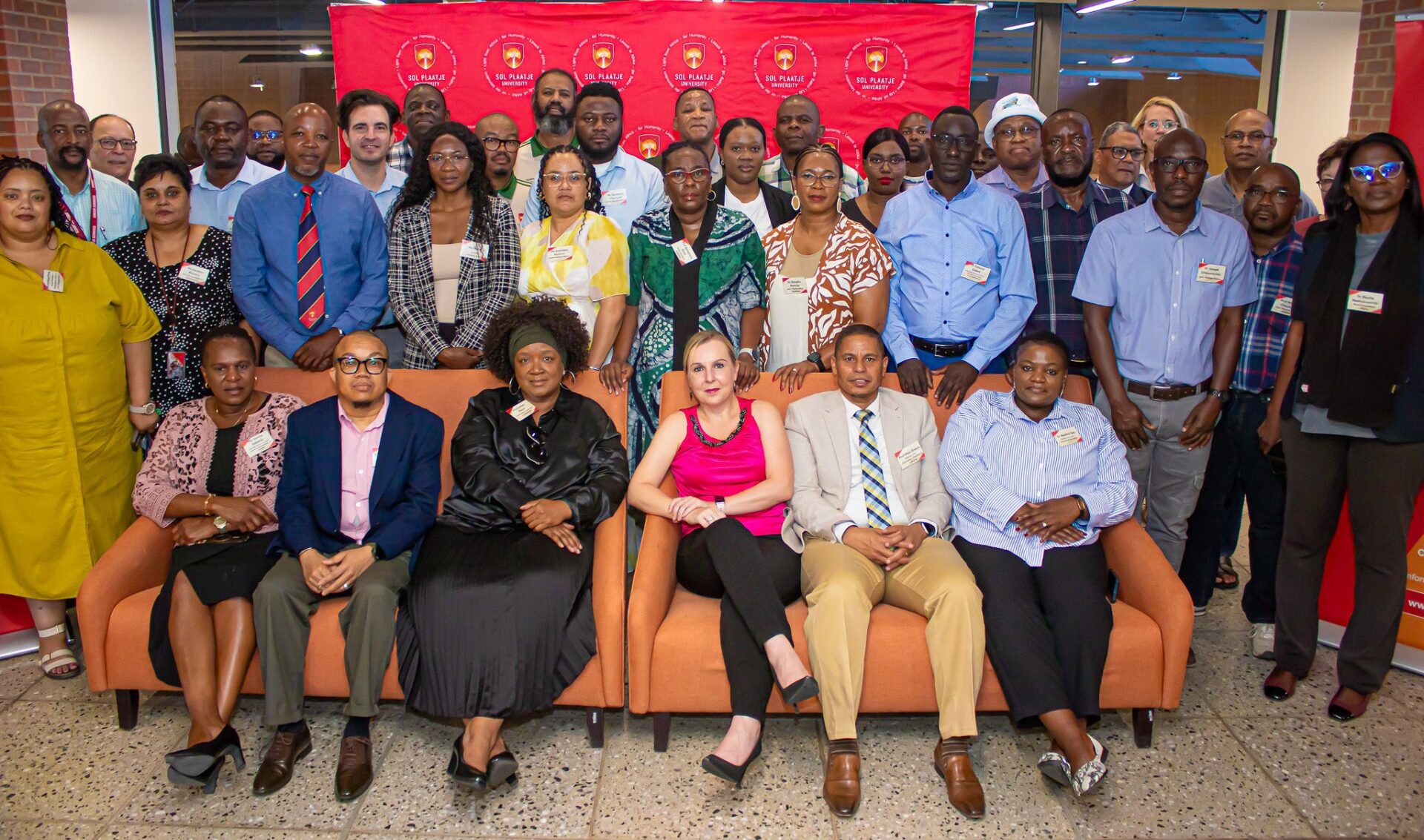
The second day of the University of Namibia’s (UNAM) visit to Sol Plaatje University (SPU) built on the academic immersion of day one, moving into high-level discussions focused on leadership, implementation and measurable outcomes of the signed Memorandum of Agreement (MoA). The engagement brought together SPU’s Management Committee, faculty deans, the Library and Research Office, and the visiting UNAM delegation to translate shared priorities into practical actions. The programme was directed by Professor Jesmael Mataga, Acting Director of Research, who facilitated the day’s proceedings and guided the collaborative exchanges.
The Acting Vice-Chancellor and Principal, Professor Debra Meyer, opened the session by emphasising that the visit marked the start of a new era of active collaboration between SPU and UNAM. She called on colleagues from both institutions to move from “a black and white document to tangible, measurable outcomes,” underscoring that the MoA must translate into practical academic achievements through joint publications, postgraduate co-supervision and collaborative research outputs that have visible impact.
She highlighted that the MoA outlines a clear scope of cooperation focused on student and staff exchange, and collaborative research across key disciplines. These include Data Science, Entrepreneurship, Agricultural Science, Education and Teacher Training, Health Sciences, Heritage Studies and Indigenous Knowledge Systems, all of which align with SPU’s strategic priorities and commitment to research productivity, innovation and capacity building.
The Acting Vice-Chancellor further encouraged faculties to use SPU’s growing portfolio of short learning programmes as models for innovation and sustainability, noting that these programmes not only expand access but also strengthen the university’s financial sustainability. “Every faculty should be able to demonstrate what they offer,” she said, inviting UNAM to explore joint delivery of selected short courses online to enhance access and reach.
She also recognised the pivotal role of the SPU Library, describing its “digital first” approach as a cornerstone of the university’s academic strategy. Linking this to SPU’s broader technological vision, she reflected on how the use of artificial intelligence, virtual reality and podcast studios are reshaping teaching, research and community engagement. From 2026, staff will be expected to demonstrate how AI integration enhances their productivity, reflecting SPU’s goal of becoming a digitally advanced and future-ready university.
Tying these priorities to the university’s internationalisation agenda, Professor Meyer affirmed that this partnership is vital for advancing academic quality, promoting research cooperation and contributing to socio-economic development. “Internationalisation strengthens our universities, our countries and our continent,” she said. “It ensures that what we do remains locally relevant while having global impact.”
She further emphasised that a university should not only generate knowledge but must also disseminate it through impactful publications. Joint projects, research outputs and postgraduate collaboration, she noted, will form the foundation of success that gives this partnership meaning. She closed by expressing appreciation for UNAM’s visit and noted the shared geography, climate and purpose that connect the two institutions. This, she said, is only the beginning, and the question that will define the collaboration in time to come is a simple one: what have we done together to strengthen our universities, serve our continent and extend our impact to the world?
Following the Acting Vice-Chancellor’s address, Professor Seth Eiseb, Campus Director of UNAM’s Southern Campus, delivered a presentation that highlighted UNAM’s commitment to regional collaboration and academic excellence. His address provided an overview of UNAM’s focus on research-driven teaching, postgraduate development and innovation aligned to national and continental priorities. He emphasised that partnerships such as the one with SPU create pathways for shared research outputs, staff and student mobility, and the co-creation of knowledge that addresses Africa’s developmental challenges through science, education and entrepreneurship.
With this strategic direction set, the day’s programme transitioned into collaborative breakout sessions where both universities engaged in discipline-specific discussions. These sessions were designed to translate the MoA into action by identifying concrete areas for cooperation and immediate next steps.
Representatives from both institutions worked collaboratively to identify areas of mutual interest across disciplines, aligning with the scope of the MoA and the strategic priorities of both institutions. The discussions produced a clear roadmap for academic cooperation, with proposed initiatives including staff exchanges, curriculum development workshops, joint postgraduate supervision and the co-hosting of academic conferences. Both sides highlighted opportunities in data science, artificial intelligence, environmental studies, and entrepreneurship, as well as in multilingual education, heritage and indigenous knowledge systems. Collaboration will also advance through open science and digital research systems, supporting emerging scholars through capacity building, mentorship and grant-writing initiatives. Professor Seth Eiseb confirmed that the University of Namibia would report back to its management on the outcomes of the visit and initiate the first steps of collaboration in the coming months.
Closing the engagement, Professor Mataga expressed appreciation for the level of commitment shown by both institutions. He noted that the visit had achieved its purpose of moving from conceptual dialogue to a clear roadmap for collaboration, and that the next stage would focus on collective accountability and measurable progress. “The true value of this partnership,” he said, “will be demonstrated through what we produce together.”
