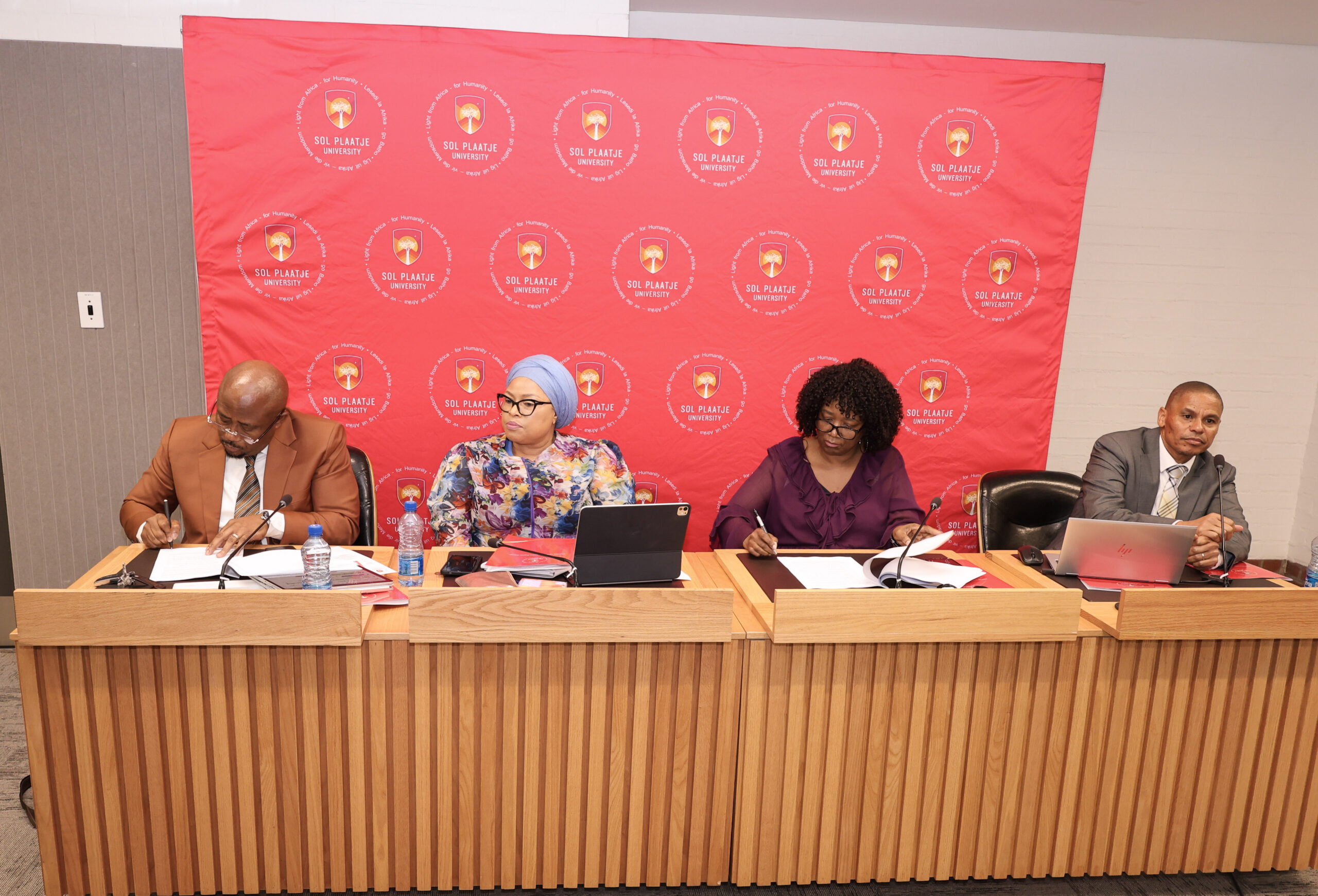
Sol Plaatje University’s (SPU) and the Northern Cape Department of Health have formalised their collaboration through the signing of a Memorandum of Agreement (MOA), marking an important step towards the proposed establishment of a Faculty of Health Sciences at the University.
The agreement was signed during an engagement held at SPU’s North Campus on 12 October 2026. The meeting brought together SPU’s executive leadership, led by Vice-Chancellor and Principal Professor Debra Meyer, and a departmental delegation led by Northern Cape MEC for Health Ms Nontobeko Vilakazi.
The engagement provided an opportunity for the two institutions to review progress, discuss the academic programmes under development and identify the practical steps required to advance health sciences education in the province.
The MOA provides a framework for continued collaboration, particularly in relation to clinical education, student placements and the alignment of SPU’s proposed academic programmes with the healthcare needs of the Northern Cape.
SPU Deputy Vice-Chancellor: Teaching and Learning, Professor Paul Green, emphasised the importance of a shared vision between the University and the Department. He noted that the proposed Faculty presented an opportunity for SPU to develop academic offerings that respond directly to the needs of the province and contribute to strengthening healthcare delivery.
The Bachelor of Nursing and Bachelor of Science in Physiotherapy have been identified as the foundational programmes for the proposed Faculty. Both are four-year professional degrees and have received approval from the SPU Senate. The University is continuing to work through the required professional-body accreditation and other regulatory processes before the programmes can be implemented.
Clinical education will be central to both programmes. Nursing students will require extensive supervised clinical training, while physiotherapy students will need workplace-based learning across several areas of practice. The partnership will therefore play an important role in identifying and facilitating suitable clinical training opportunities at healthcare facilities throughout the Northern Cape.
SPU and the Department will explore placements beyond Kimberley to ensure that students gain experience in a range of healthcare settings and communities. This approach is expected to broaden students’ practical exposure while supporting healthcare facilities in rural and underserved parts of the province.
Professor Meyer welcomed the partnership and reflected on SPU’s growth since its establishment in 2014. The University now has approximately 9,500 students, an expanding academic offering and a growing research profile. More than 4,000 students have graduated from SPU, many of whom are the first members of their families to obtain university qualifications.
She highlighted the University’s responsibility to respond to the educational and developmental priorities of the Northern Cape. The proposed Faculty of Health Sciences forms part of this broader institutional vision and will expand opportunities for young people to pursue professional healthcare qualifications closer to home.
MEC Vilakazi highlighted the need to strengthen the province’s capacity to train and retain healthcare professionals. For many years, students from the Northern Cape have had to study health-related qualifications outside the province, with some not returning after completing their training.
Developing health sciences programmes locally is intended to create a more sustainable pipeline of professionals who understand the province’s communities and healthcare challenges. It could also support efforts to improve recruitment and retention, particularly in rural areas where healthcare facilities continue to experience staffing pressures.
While nursing and physiotherapy are planned as the initial offerings, SPU’s long-term vision includes postgraduate study, professional development and further qualifications in specialised areas of health sciences. Potential areas for future development include emergency medical care, occupational therapy, biomedical sciences, medical imaging, social work and medical training. These possibilities remain subject to detailed planning, feasibility assessments, resource availability and the relevant institutional and regulatory approvals.
The University is also developing a business plan to support the proposed Faculty’s financial sustainability and long-term growth. Continued cooperation with the Department of Health will be essential to aligning academic planning with clinical training capacity and the province’s healthcare workforce requirements.
The signing builds on earlier discussions between SPU and the Department and reflects a shared commitment to translating the vision for health sciences education into action. The two institutions will maintain ongoing communication, undertake further consultations and continue working through the academic, clinical, regulatory and operational requirements associated with the proposed Faculty.
Through this partnership, SPU and the Northern Cape Department of Health are laying the groundwork for expanded access to professional healthcare education, a stronger local healthcare workforce and a sustainable pipeline of practitioners equipped to serve communities across the province.
