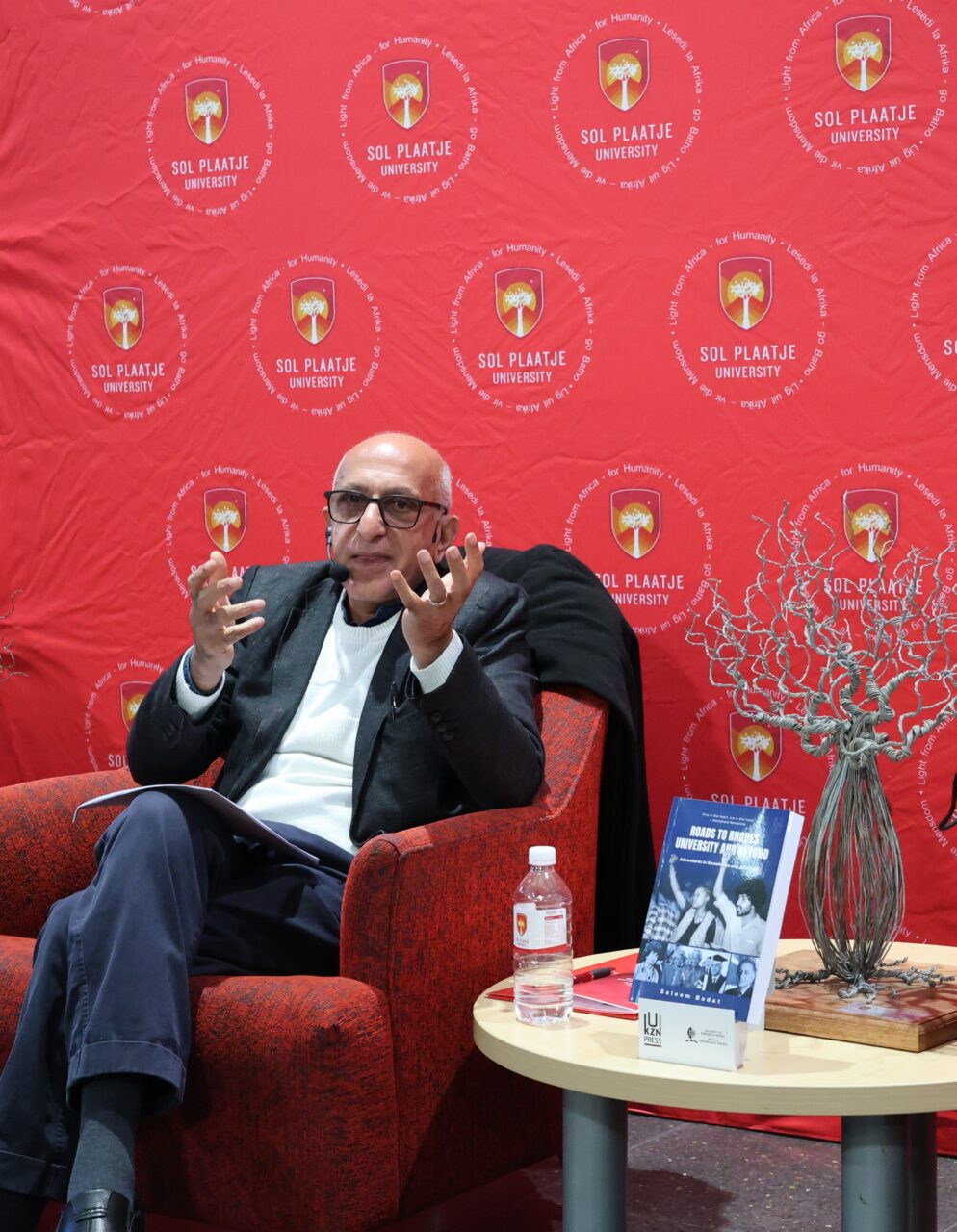
Sol Plaatje University (SPU) hosted the launch of Professor Saleem Badat’s book, Roads to Rhodes University and Beyond: Adventures in Knowledge and Activism, on 6 July 2026. The event brought together staff, students, scholars and members of the public for a wide-ranging discussion on universities, leadership, transformation and the public good.
Professor Badat is a renowned sociologist, higher education scholar and former Vice-Chancellor of Rhodes University. Blending memoir, institutional reflection and critical analysis, the book draws on his experiences as a scholar, activist and university leader to examine higher education in South Africa.
In welcoming guests, Professor Russel Viljoen, Dean of the Faculty of Humanities, said SPU was honoured to host the event. “This launch is not only an opportunity to acknowledge a significant scholarly contribution, but also to reflect on the importance of the conversations, deliberations and debates that this work invites us to engage in,” he said.
Professor Dipane Hlalele, Dean of the Faculty of Education, directed the programme and noted that book launches provide opportunities for academics, students and communities to engage with contemporary issues through research and lived experience. Dr Phindile Dlamini, Director of UKZN Press, described the publication as a significant contribution to the field of higher education, noting its combination of theory and practice.
A panel of SPU academics then reflected on the book. Dr Violet Pule, Lecturer in Setswana, presented on behalf of Ms Lesego Bertha Kgatitswe and highlighted the role of memoir and intellectual biography in preserving histories of Black scholarship, activism and institutional transformation. Professor Jesmael Mataga, Associate Professor in Museum and Heritage Studies, described the book as personal and deeply relatable. He also reflected on SPU’s opportunity, as a young university, to build a distinctive institutional culture. Professor Anthony Mpisi, Associate Professor in Psychology of Education, traced Professor Badat’s journey after Rhodes University, including his work with the Andrew W. Mellon Foundation and his continuing engagement with transformation, inequality and social justice.
Vice-Chancellor and Principal Professor Debra Meyer reviewed the book’s final section, which examines leadership, transformation and the state of South African universities. She highlighted its case for ethical, principled and distributed leadership, as well as for transformation that extends beyond representation to include epistemic, cultural and structural change. Reading the section from the perspective of a university leader, she concluded that its chapters “function as a blueprint for vice-chancellors and other university leaders” and said the book “should be prescribed reading for everyone who considers themselves a university leader or who wants to become one.”
Responding to the panel, Professor Badat reflected on the purpose of universities and the importance of developing the next generation of scholars. He emphasised that universities must remain committed to producing and disseminating knowledge while ensuring that this work responds to society’s development needs.
The launch concluded with a question-and-answer session on accountability, leadership, institutional culture and the role of universities in advancing social equity and democratic life. The discussion made the event more than a celebration of a publication; it became a serious reflection on the purpose of universities and how they should serve society.
