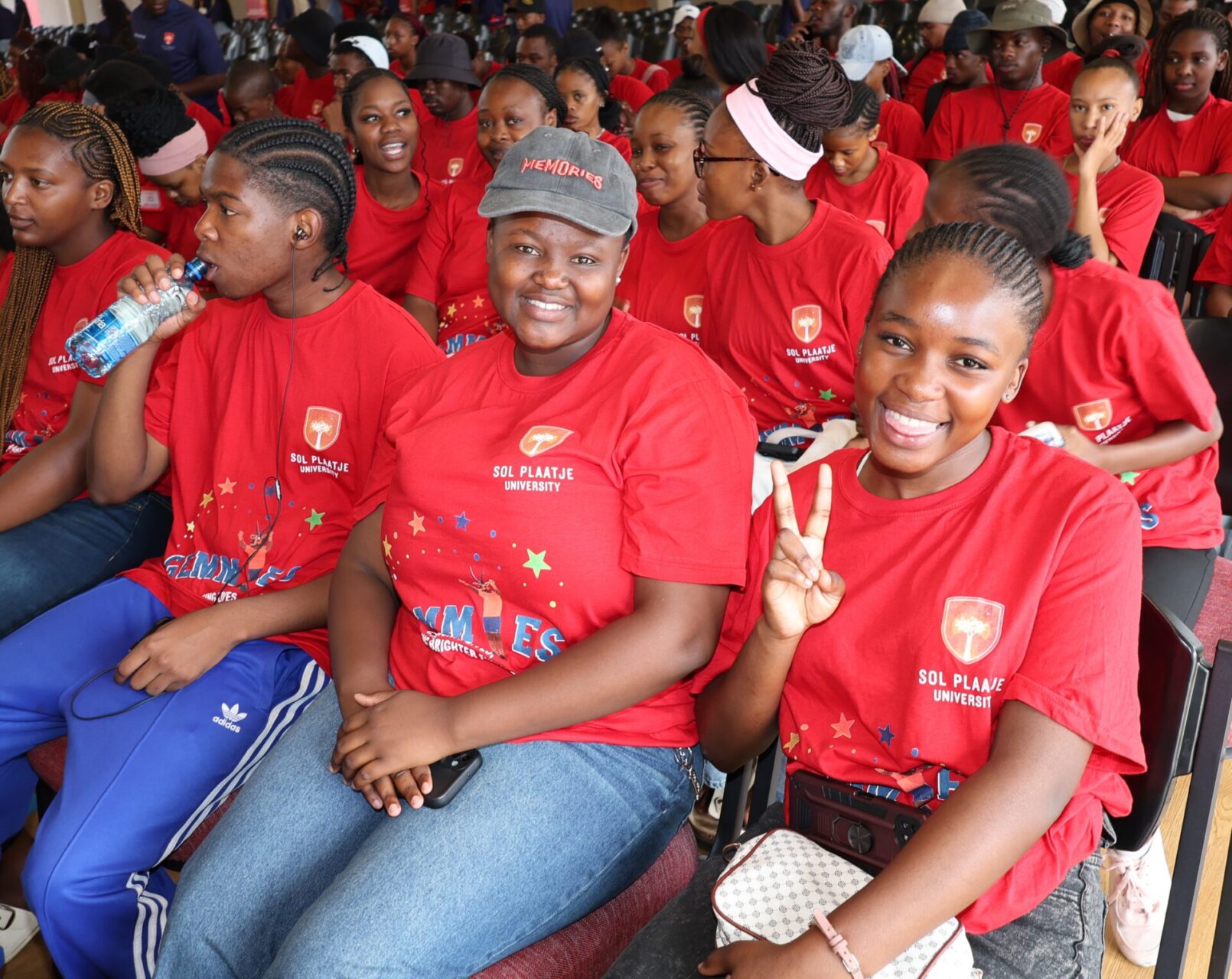
Sol Plaatje University (SPU) formally welcomed its first-time entering students for the 2026 academic year on Saturday, 7 February, at the Vice-Chancellor’s Official Welcome Ceremony held in the SPU Great Hall, alongside the university’s senior executive leadership.
Addressing students, parents and the broader university community, Vice-Chancellor and Principal Professor Debra Meyer, together with the executive management, framed the moment as one of earned arrival, purpose and responsibility. She reminded students that admission to university in South Africa is neither automatic nor guaranteed, and that their presence at SPU represents perseverance in the face of significant structural and personal challenges.
“Getting into university is not a small achievement,” Professor Meyer said. “You worked for this. You earned this.”
Situating the Class of 2026 within the national schooling context, the Vice-Chancellor highlighted that only a portion of learners who begin Grade 1 complete matric, and that the 2025 matric cohort was the largest in South Africa’s history, producing a record number of bachelor passes. Against this backdrop, she described SPU’s first years as an exceptional group of young people whose academic journeys reflect resilience, discipline and determination.
Professor Meyer emphasised that Sol Plaatje University was established with intent, not by chance. Founded in 2014 as the first and only public university in the Northern Cape, SPU exists to ensure that geography does not determine destiny and that opportunity reaches talent wherever it exists. She noted the university’s growth from fewer than 150 students at inception to a projected enrolment approaching 8 000 students, with the current first-year intake standing at 2 960 students, 68 percent of whom are women. 25 percent of the cohort originates from the Northern Cape, affirming the institution’s regional mandate while attracting students from all nine provinces.
“You are joining a young institution, not a new one,” she said. “An institution that is bold, intentional and growing. And now, you are part of its story.”
Drawing on the symbolism of Kimberley as a city shaped by mining, Professor Meyer encouraged students to reframe challenge and pressure as conditions for growth rather than signs of failure. She reminded students that diamonds are formed under intense pressure and over time, and that intellectual and personal development follows a similar path.
At the heart of her message was belonging. Professor Meyer affirmed that students are at SPU because they belong here and because the institution has a responsibility to support their success. She emphasised that university life demands ownership, self-discipline and persistence, and that success is shaped not only by intelligence but by time management, curiosity and the willingness to ask for help.
“SPU exists to help you succeed,” she said. “Your success is what gives this university its right to exist.”
The symbolic passing of the Beacon of Light reinforced this message of continuity, responsibility and shared purpose. Facilitated by the Senior Manager for Student Life and Development, Mr Buntu Mnyaka, the ceremony marked the transition of knowledge, values and institutional legacy from one student generation to the next. The beacon, representing knowledge, wisdom, hope and service, was passed from a second-year student to a first-year cohort, affirming that education is entrusted, not owned, and must be carried forward with integrity and accountability.
Speaking on behalf of the student body, SRC President Gershwin Dimitri Van Niekerk, welcomed first-year students from the perspective of shared experience and responsibility. He acknowledged the uncertainty that often accompanies the transition into university life and reaffirmed the role of the SRC as a representative and support structure for students. Emphasising education as a tool for social advancement, he encouraged students to participate actively not only in academic life, but in dialogue, leadership and shaping a more just and accessible higher education environment.
The ceremony reflected SPU’s commitment to holistic student development, academic excellence and ethical leadership, with a clear emphasis on purpose that reinforced the university’s values of dignity, integrity, justice and service to society.
In closing her address, Professor Meyer invited students to imagine themselves returning to the Great Hall at graduation, changed not only by what they have learned, but by who they have become. She drew attention to the university’s emblem, the quiver tree, whose star-shaped leaves symbolise graduates sent into the world as light.
“Education does not change the world,” she said. “Educated people do.”
